
Ounce of Weed: Top Guide to 2025 Costs and Uses
Understanding cannabis measurements is essential for anyone navigating marijuana, whether you’re a seasoned consumer or just beginning your journey. An ounce of weed, commonly called an “O,” “lid,” or “zip,” is a key unit of measurement in this field, comprising exactly 28 grams of cannabis. If you’re curious about how this stacks up to smaller amounts, here’s a quick guide:
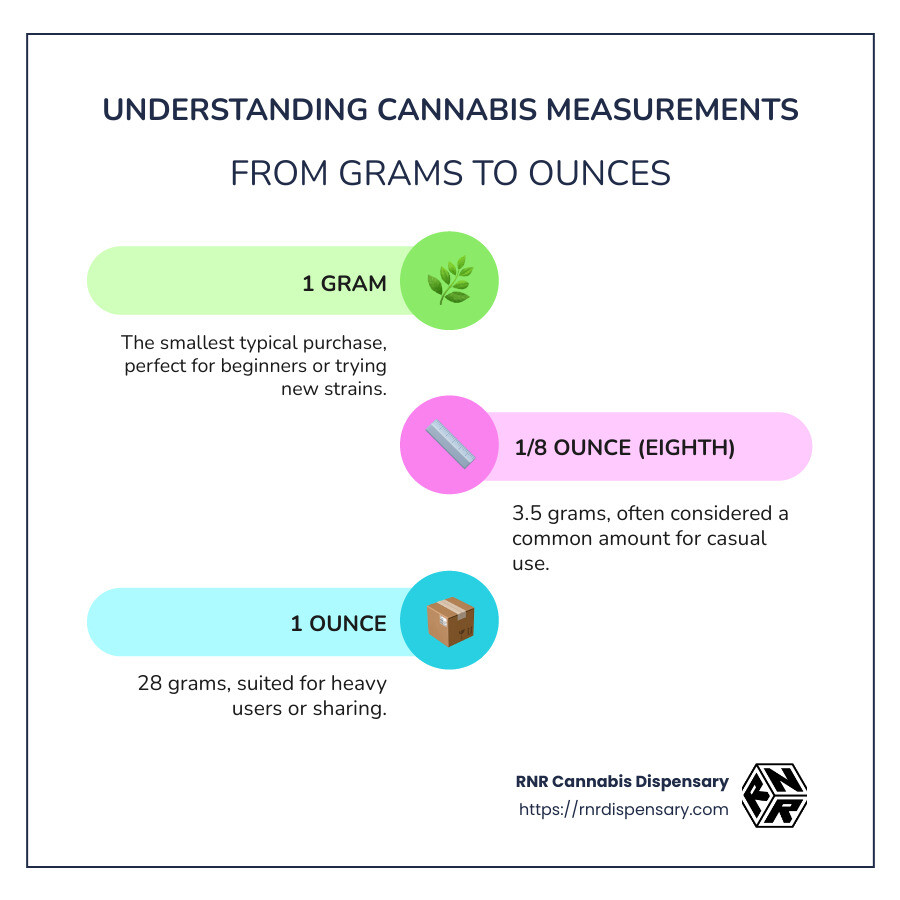
- 1 Gram: The smallest typical purchase.
- 1/8 Ounce (Eighth): 3.5 grams, often considered a common amount for casual use.
- 1/4 Ounce (Quarter): 7 grams, ideal for more regular consumption.
- 1 Ounce: 28 grams, suited for heavy users or sharing.
Whether you’re looking to buy a few grams or stock up with a full ounce, understanding these terms helps you make informed decisions that match your consumption needs and lifestyle.
I’m Ronald Shen, a community leader and cannabis enthusiast who has dedicated years to understanding everything about weed, including the specifics of an ounce of weed. With my background in operating a cannabis dispensary in Bushwick, I can help unpack the nuances of weed quantities and offer insight into what best suits your needs. Let’s dive deeper into understanding this vital aspect of cannabis consumption.
Cannabis Measurements Explained
When diving into cannabis measurements, it’s important to understand the different units used. These measurements help you make informed decisions about how much to purchase and how to use it. Let’s break down the most common terms: grams, eighths, quarters, and ounces.
Grams and Eighths
Grams are the smallest unit of measurement for cannabis. They are ideal for those who are new to cannabis or prefer smaller quantities. A single gram is often enough for a joint or two, making it perfect for a quick session or trying out a new strain.
An eighth, or 1/8 of an ounce, is equivalent to 3.5 grams. This is one of the most common purchases among casual users. It’s a manageable amount that provides several sessions of enjoyment without committing to a larger quantity. Eighths are popular because they offer a balance between quantity and cost, allowing users to experiment with different strains without breaking the bank.
Quarters and Ounces
Moving up in quantity, a quarter represents 1/4 of an ounce, or 7 grams. This amount is great for regular users who want a bit more flexibility in their consumption. With a quarter, you can roll multiple joints or blunts, or even try your hand at making edibles.
An ounce of weed is the largest common measurement and equals 28 grams. This amount is suitable for heavy users or those who prefer to buy in bulk to save money. An ounce offers plenty of possibilities for consumption, from rolling numerous joints to creating infused oils. It’s also a popular choice for sharing among friends or for those who use cannabis for medical purposes.
Understanding these measurements allows you to buy the right amount for your needs. Whether you’re looking for a small taste or ready to stock up, knowing the difference between grams, eighths, quarters, and ounces ensures you get exactly what you’re looking for.
What Does an Ounce of Weed Look Like?
Visualizing an ounce of weed can be a bit tricky. Its appearance can change based on the strain’s density and moisture content. Let’s break it down so you can get a better idea of what an ounce might look like in real life.
Density and Moisture
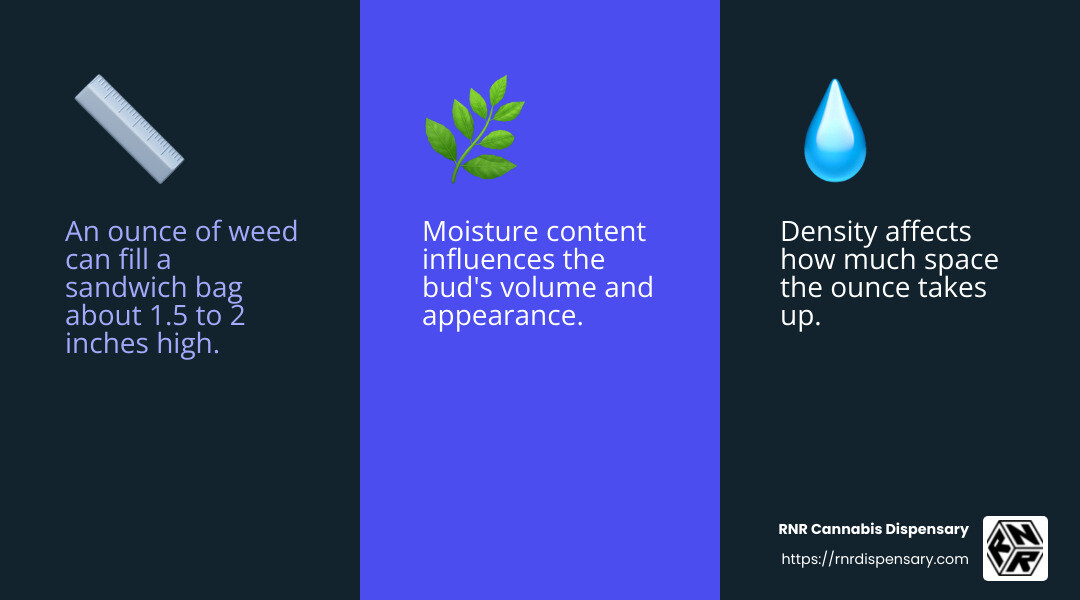
The density of cannabis buds plays a big role in how an ounce appears. Some strains produce light, fluffy buds that take up more space. In contrast, dense strains are more compact and take up less space even though they weigh the same.
Moisture content also affects how cannabis looks. If the buds are dry, they might appear smaller and more crumbly. On the other hand, fresh and moist buds are fuller and more vibrant in color.
Sandwich Bag Comparison
A common way to visualize an ounce of weed is by using a small sandwich-size baggie. Typically, an ounce of weed can fill this type of baggie quite nicely. Imagine the bag filled about 1.5 to 2 inches high with cannabis.
Another comparison is to think of a slice of bread. When broken down, an ounce of weed might cover a similar area as a slice, but this isn’t an exact science. The density and moisture of the buds can make the visual comparison vary.
Understanding what an ounce of weed looks like helps you better gauge your purchases. Whether you’re buying a dense indica or a fluffy sativa, knowing how an ounce should look can ensure you get the right amount for your needs.
How Much Does an Ounce of Weed Cost?
The cost of an ounce of weed can vary significantly. Several factors contribute to these variations, including quality, strain, state laws, and taxes.
Factors Influencing Price
Quality and Strain
The quality of cannabis greatly affects its price. High-quality weed, often rich in trichomes and aroma, usually commands a higher price than lower-quality options. According to research, the average cost of an ounce of high-quality weed in the U.S. is about $318.72, while medium-quality weed averages around $256.08. The strain also plays a role; unique or highly sought-after strains might be more expensive.
State Laws and Taxes
Where you live affects how much you’ll pay for an ounce. Different states have varying laws and taxes on cannabis. For instance, in the District of Columbia, an ounce of high-quality weed can cost as much as $590.27 due to high taxes and regulations. Conversely, states like Oregon, with more lenient laws, have lower prices, averaging $210.19 for high-quality weed. Local taxes can further increase the price, making it essential to understand how your location impacts costs.
Market Conditions and Supply-Demand
Market dynamics like supply and demand also influence the price of cannabis. When demand is high and supply is low, prices tend to rise. Conversely, an oversupply can lead to lower prices. For example, as more states legalize cannabis, the increased competition and production might drive prices down over time. The U.S. cannabis market is projected to generate significant revenue, potentially impacting prices as the industry matures.
Understanding these factors can help you make informed decisions when purchasing an ounce of weed. Always consider quality, local laws, and current market conditions to find the best value for your needs.
What Can You Do with an Ounce of Weed?
When you have an ounce of weed, the possibilities are vast. This amount, about 28 grams, is perfect for trying different consumption methods. Whether you prefer smoking, vaping, or cooking, an ounce can serve you well.
Rolling and Packing
Joints and Blunts
With an ounce, you can roll approximately 28 joints, as each typically contains about one gram of cannabis. For those who prefer blunts, which are larger than joints, you can roll around 20 blunts from an ounce, using about 1.5 grams for each. Blunts use cigar or hemp leaf wraps, offering a different experience compared to joints.
One-Hitters
If you enjoy smaller doses, consider using a one-hitter. This small pipe uses about 0.25 grams of cannabis per pack. With an ounce, you can pack roughly 120 one-hitters, making it an efficient choice for those who prefer a quick, discreet puff.
Making Edibles
Cannabutter and Infused Oils
An ounce of weed is also great for making edibles. You can create cannabutter by simmering ground cannabis with butter, then straining out the plant material. This infused butter can be used in various recipes, from cookies to brownies, allowing you to enjoy the effects without smoking.
For a versatile option, try making infused oils. By infusing cannabis into oils like coconut or olive oil, you can create a base for salad dressings or saut

 English